
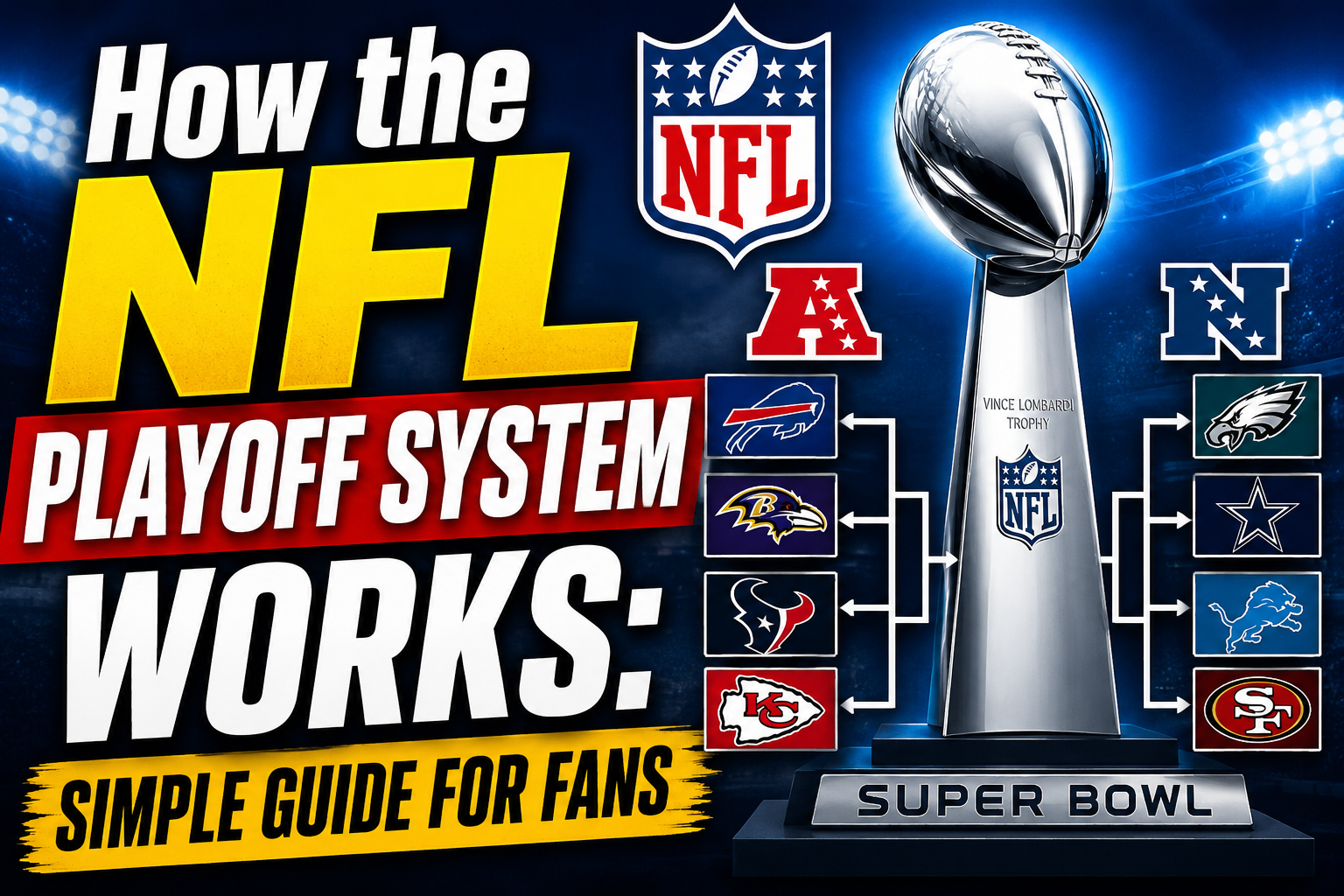
The NFL regular season is exciting, but the playoffs bring a different kind of pressure. Every snap matters more. Every mistake feels bigger. Every’s team knows that one bad game can end its season. That is why fans love the postseason so much. It is intense, emotional, and unpredictable.
For newer fans, the NFL playoff system can seem confusing at first. Terms like Wild Card, seeding, bye week, conference championship, and tiebreakers are used often, but not everyone understands what they mean. Once you learn the basics, the playoff picture becomes much easier to follow.
The current NFL postseason includes 14 teams total, with seven teams from the AFC and seven teams from the NFC. This format was introduced in 2020 and continues to shape the modern playoff race. 1
What Is the NFL Playoff System?
The NFL playoff system is the tournament that decides which team becomes Super Bowl champion. After the regular season ends, the best teams from each conference move into the postseason. From there, teams play elimination games until only two remain: the AFC champion and the NFC champion.
Those two conference champions meet in the Super Bowl.
Unlike the regular season, the playoffs do not allow much room for recovery. If a team loses a playoff game, its season is over. If it wins, it advances to the next round. This single-elimination format is one of the biggest reasons NFL playoff games feel so dramatic.
A great regular season can help a team earn a better seed, home-field advantage, or a first-round bye. But once the playoffs begin, every team has to prove itself again.
How Many Teams Make the NFL Playoffs?
Fourteen teams make the NFL playoffs. Seven come from the AFC, and seven come from the NFC. Each conference sends its four division winners plus three Wild Card teams. 2
The four division winners are the teams that finish first in their divisions. The Wild Card teams are the best remaining teams in the conference that did not win their division.
This setup keeps the playoff race interesting. A team does not have to win its division to reach the postseason. If it has a strong enough record, it can still qualify as a Wild Card team.
That is why fans closely follow standings late in the season. A team may be out of the division race but still alive for a Wild Card spot. On the other hand, a division leader may still be fighting for a better seed.
What Is Playoff Seeding?
Seeding is how playoff teams are ranked inside each conference. The No. 1 seed is the highest-ranked team in the conference. The No. 7 seed is the lowest-ranked playoff team.
In general, the four division winners receive the top four seeds. The three Wild Card teams receive seeds five through seven. Records matter, but division winners are rewarded because winning a division is considered important.
The No. 1 seed is especially valuable because it is the only team in each conference that gets a first-round bye under the current format. That means the No. 1 seed does not play during Wild Card Weekend and automatically advances to the Divisional Round. 1
That bye week can be a major advantage. It gives players extra rest, allows injured players more time to recover, and gives coaches extra time to prepare.
What Happens in the Wild Card Round?
The Wild Card Round is the first round of the NFL playoffs. Since the No. 1 seed gets a bye, the other six teams in each conference play during this round.
The matchups usually work like this:
- No. 2 seed vs. No. 7 seed
- No. 3 seed vs. No. 6 seed
- No. 4 seed vs. No. 5 seed
The higher seed usually hosts the game. That means the No. 2, No. 3, and No. 4 seeds normally get home-field advantage in the Wild Card Round.
Wild Card games are often unpredictable. Sometimes a lower-seeded team enters the playoffs with momentum and beats a higher seed. Other times, a strong division winner handles business at home.
This round is where playoff dreams begin for many teams. A Wild Card team may not have had a perfect regular season, but once it gets into the tournament, anything can happen.
What Is the Divisional Round?
After the Wild Card Round, the winners move on to the Divisional Round. This is where the No. 1 seed enters the playoffs.
The Divisional Round usually feels even more intense because only four teams remain in each conference. The competition is stronger, and the stakes are higher.
The No. 1 seed plays one of the Wild Card winners. The other two remaining teams in the conference face each other. The exact matchups depend on the bracket and results from the Wild Card Round.
For many fans, the Divisional Round is one of the best weekends of football. Teams are fresh enough to play at a high level, but the pressure is already enormous. One win puts a team one step away from the Super Bowl. One loss ends everything.
What Are the Conference Championship Games?
The winners of the Divisional Round move on to the Conference Championship games. There is one AFC Championship Game and one NFC Championship Game.
The AFC Championship decides the AFC representative in the Super Bowl. The NFC Championship decides the NFC representative.
These games are often remembered for years. They decide legacies. Quarterbacks are judged by them. Coaches build reputations in them. Fan bases never forget the heartbreak or joy that comes from winning or losing one game away from the Super Bowl.
For many players, reaching a conference championship is a major achievement. But the goal is not just to get there. The goal is to win and earn a spot on football’s biggest stage.
How Teams Reach the Super Bowl
The Super Bowl is the final game of the NFL season. It features the AFC champion against the NFC champion. The winner becomes the NFL champion.
To get there, a team must survive the playoff bracket. A No. 1 seed has the shortest path because it skips the Wild Card Round. Other teams must win three playoff games before reaching the Super Bowl.
This is why seeding matters so much. A higher seed can mean home-field advantage, a better matchup, or even one fewer game to play. In a physical sport like football, that can make a real difference.
Still, the playoffs are not always predictable. Lower-seeded teams have gone on deep runs before. Sometimes a team gets hot at the right time, finds its identity late in the season, and becomes dangerous in January.
Why Home-Field Advantage Matters
Home-field advantage can play a big role in the NFL playoff system. Playing at home means a team gets support from its fans, avoids travel, and plays in a familiar stadium.
Crowd noise can make life difficult for visiting offenses. Quarterbacks may struggle to communicate. Offensive linemen may have trouble hearing snap counts. False starts and missed assignments become more likely.
Weather can also matter. Some teams are built for cold, wind, or outdoor conditions. Others may be more comfortable in domes or warm climates. A playoff game in a tough environment can become a major challenge for the visiting team.
Home-field advantage does not guarantee a win, but it is one reason teams fight hard for better playoff seeding during the regular season.
What Are NFL Tiebreakers?
Sometimes, teams finish the regular season with the same record. When that happens, the NFL uses tiebreakers to decide division winners, Wild Card spots, and playoff seeding.
Tiebreakers can include head-to-head record, division record, conference record, and other factors. These rules can become very important late in the season.
For example, two teams may both finish with 10 wins. If one team beat the other during the regular season, that head-to-head win may help decide who gets the higher seed or who makes the playoffs.
This is why every game matters, especially division games and conference games. A win in September can become important in January.
Why the NFL Playoff System Is So Exciting
The NFL playoff system works well because it rewards regular-season success while still allowing surprise runs. The best teams earn advantages, but no team is completely safe once the postseason begins.
The single-elimination format creates drama. There is no seven-game series. There is no second chance the next night. One great performance can create history. One mistake can end a season.
That pressure is what makes NFL playoff football special. A blocked kick, a late interception, a goal-line stand, or a final-minute touchdown can become a legendary moment.
Fans watch because anything can happen.
Final Thoughts
Understanding the NFL playoff system makes the season more enjoyable. Once you know how teams qualify, how seeding works, what the Wild Card Round means, and why the No. 1 seed is so valuable, the playoff race becomes much easier to follow.
Fourteen teams enter the postseason. Only two reach the Super Bowl. Only one becomes champion.
That journey is what makes the NFL playoffs one of the most exciting events in sports. Every team is chasing the same dream, but the path is difficult, physical, and full of pressure.
In the end, the playoffs are simple: win and advance, lose and go home. That is why every game feels unforgettable.


No comment