
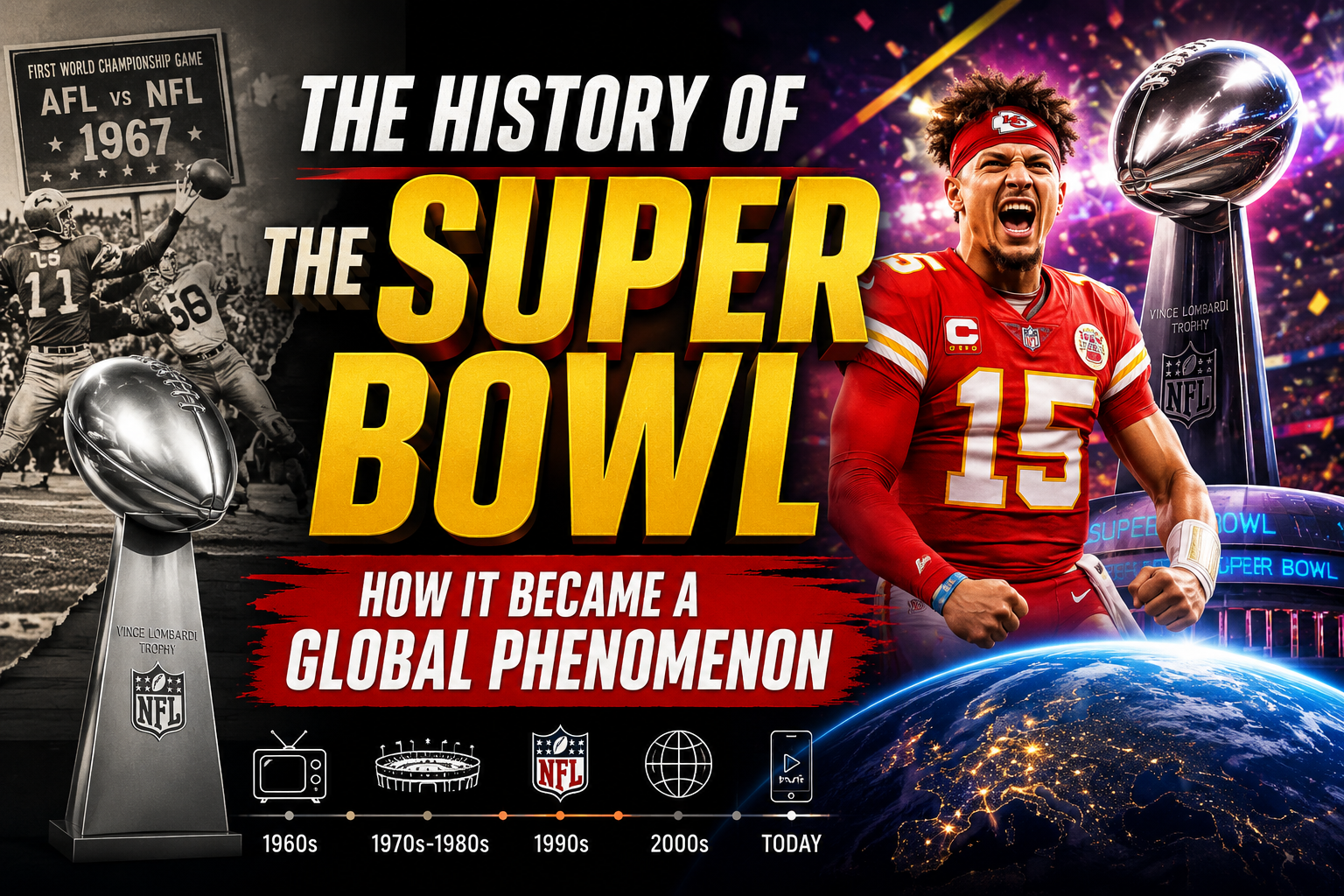
Every February, the world effectively stops on a Sunday evening. Millions of people gather around flat-screen televisions, consume an unfathomable amount of chicken wings and guacamole, and tune in to the biggest spectacle in modern entertainment. The Super Bowl is no longer just a championship football game; it is a global cultural holiday History of the Super Bowl.
As we look toward the culmination of the 2026 NFL season—which will bring us to the milestone of Super Bowl LX (60)—it is hard to imagine a time when this event wasn’t a multi-billion-dollar juggernaut. But the origins of the big game are surprisingly humble, rooted in a bitter rivalry between two competing football leagues.
If you want to understand the modern gridiron, you must understand how we got here. Let’s take a deep dive into the fascinating history of the Super Bowl, exploring its evolution from a half-empty stadium in Los Angeles to the undisputed king of global television.
The Rivalry and the AFL-NFL Merger
To understand the first Super Bowl, you have to go back to the 1960s. The National Football League (NFL) had been the dominant professional football league for decades. However, a group of wealthy businessmen who were denied the opportunity to buy NFL franchises decided to start their own league: the American Football League (AFL).
Led by Lamar Hunt, the owner of the Dallas Texans (who later became the Kansas City Chiefs), the AFL was flashy, offensive-minded, and directly challenged the older, conservative NFL. A fierce bidding war for college players began, driving up salaries and threatening to bankrupt both leagues.
Realizing that this war of attrition was bad for business, NFL Commissioner Pete Rozelle and AFL founders negotiated a truce in 1966. This agreement was the monumental AFL NFL merger. They agreed to a common draft, integrated schedules, and most importantly, an end-of-season championship game played between the winners of the two leagues.
Originally clunkily named the “AFL-NFL World Championship Game,” Lamar Hunt jokingly referred to it as the “Super Bowl” in a meeting, allegedly inspired by a high-bouncing “Super Ball” toy his children played with. The media caught wind of the name, and the moniker stuck forever.
Super Bowl I and II: The Lombardi Dominance
The first iteration of the big game was played on January 15, 1967, at the Los Angeles Memorial Coliseum. By today’s standards, it was an underwhelming affair. Tickets cost just $12, and the stadium was completely sold out—not because of high demand, but because roughly 30,000 seats sat empty.
The Green Bay Packers, representing the mighty NFL, were coached by the legendary Vince Lombardi. The NFL establishment viewed the AFL as an inferior, amateurish league. Lombardi felt an immense, crushing pressure to defend the pride of the NFL against the AFL’s Kansas City Chiefs.
The Packers dismantled the Chiefs 35-10 in Super Bowl I, and returned the following year to easily defeat the Oakland Raiders in Super Bowl II. After Lombardi passed away from cancer in 1970, the league honored his legacy by renaming the championship hardware the Vince Lombardi Trophy.
The Turning Point: Namath’s Guarantee in Super Bowl III
Heading into Super Bowl III in 1969, the narrative was fixed: the NFL was vastly superior to the AFL. The NFL’s Baltimore Colts were viewed as one of the greatest teams in history and were favored by a staggering 18 points over the AFL’s New York Jets.
Then, Jets quarterback “Broadway” Joe Namath did the unthinkable. Days before the game, while sitting poolside in Miami, Namath boldly told reporters, “We’re going to win Sunday. I guarantee it.”
The football world scoffed, but on Sunday, Namath orchestrated one of the greatest upsets in sports history. The Jets defeated the Colts 16-7. This single game proved the AFL could compete with the NFL, validating the merger and cementing the Super Bowl as a must-watch, highly competitive event.
The Decades of Dynasties
As the 1970s and 1980s rolled around, the Super Bowl transformed from a mere championship game into the era of dynasties.
- The 1970s: The Pittsburgh Steelers dominated the decade. Led by the “Steel Curtain” defense and quarterback Terry Bradshaw, the Steelers captured four Super Bowl titles in a six-year span, building a massive national fanbase.
- The 1980s and 90s: The San Francisco 49ers revolutionized the sport with the West Coast Offense. Joe Montana and Jerry Rice made the Super Bowl their personal playground. Shortly after, the Dallas Cowboys built an unstoppable roster that won three championships in four years, earning the moniker “America’s Team.”
During these decades, television ratings skyrocketed. Networks realized that this single game had the power to captivate over 100 million Americans simultaneously.
The Evolution of the Halftime Show
In the early days of the Super Bowl, the halftime show was essentially a bathroom break. Entertainment consisted of college marching bands, drill teams, and the relentlessly upbeat vocal group “Up With People.”
Everything changed during Super Bowl XXVII in 1993. The NFL realized they were losing viewers during halftime to counter-programming on competing networks. To stop the bleeding, they booked the biggest pop star on the planet: Michael Jackson. Jackson’s legendary performance proved that the halftime show could be a standalone mega-event.
Since then, the Super Bowl halftime show has featured music royalty: Prince (giving an iconic performance in the pouring rain), U2 (delivering a powerful tribute after 9/11), Beyoncé, Dr. Dre, Rihanna, and Usher. Today, artists perform for free, knowing the exposure to 120 million viewers will skyrocket their music streams and concert ticket sales.
The Billion-Dollar Commercials
You cannot talk about the Super Bowl without talking about the commercials. The watershed moment arrived in 1984 when Apple hired film director Ridley Scott to direct a dystopian, cinematic advertisement for the Macintosh computer. It only aired once during Super Bowl XVIII, but it completely changed advertising forever.
Suddenly, corporations realized that people were watching the Super Bowl for the commercials. Advertisers began creating exclusive, highly anticipated mini-movies. Fast forward to 2026, and a standard 30-second ad slot during the game costs companies well over $7 million. For brands, it is the ultimate marketing gamble on the biggest stage imaginable.
The Modern Spectacle
As we march through the 2026 NFL season, the Super Bowl has transcended American borders. It is broadcast in over 130 countries and over 30 languages. The modern era was largely defined by the unprecedented dominance of Tom Brady and the New England Patriots (and later, the Buccaneers), who captured seven rings over two decades.
Now, a new generation of superstars, led by alien-like athletes like Patrick Mahomes, are writing the next chapters of this incredible story. But no matter how advanced the passing schemes get, or how luxurious the host stadiums become, the core of the Super Bowl remains the same.
It is 60 minutes of football to achieve athletic immortality. It is the pursuit of the Vince Lombardi Trophy. From a half-empty stadium in Los Angeles to a global cultural phenomenon, the history of the Super Bowl is the ultimate American success story.
No comment