
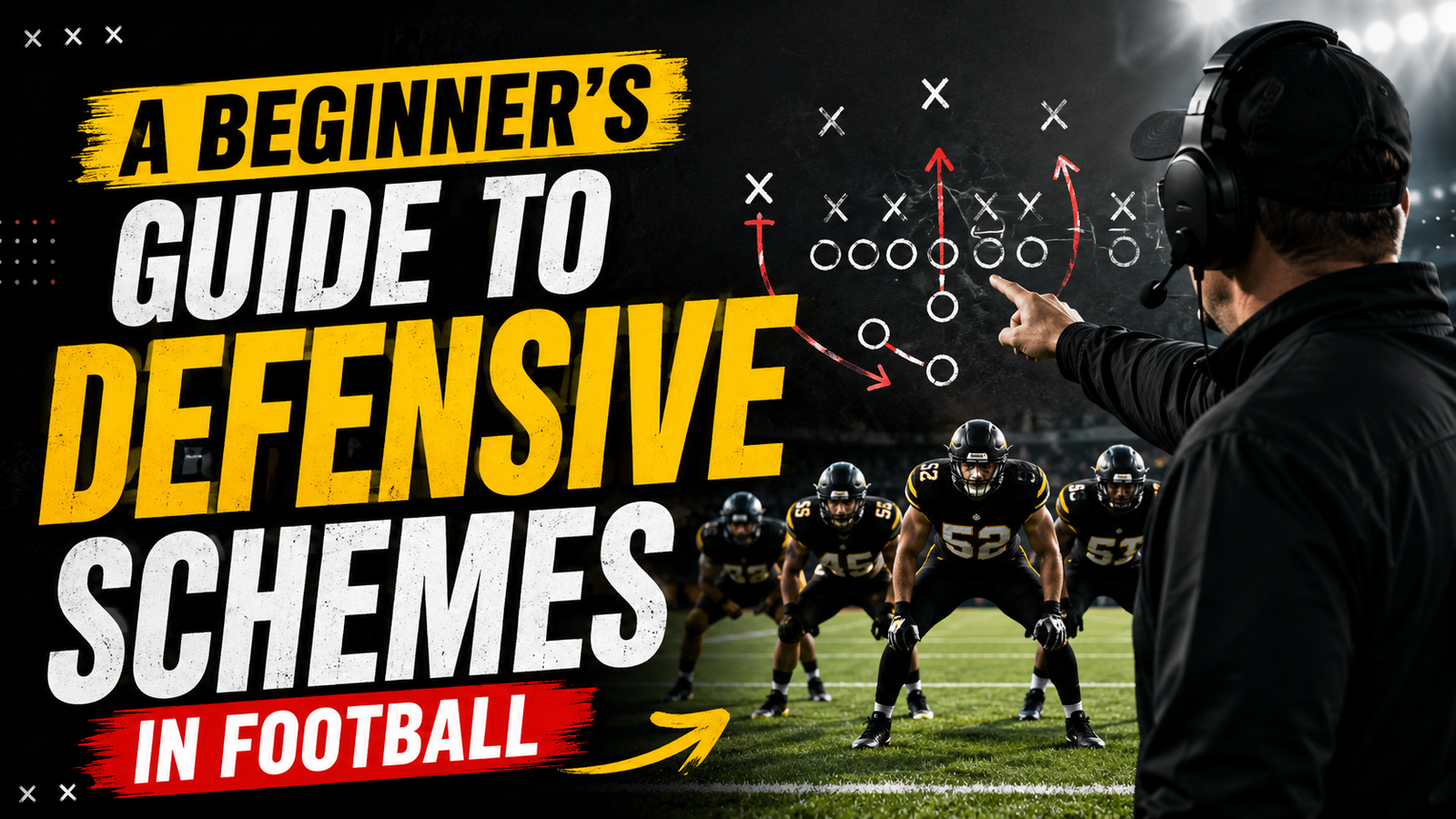
We have all heard the oldest cliché in sports: “Offense wins games, but defense wins championships.” While the 2026 NFL season is dominated by highlight-reel catches and superstar quarterbacks throwing for 4,000 yards, the complex chess match being played by defensive coordinators is often the deciding factor in January playoff games.
When you watch a football game on television, the broadcast often focuses heavily on the quarterback’s perspective. The commentators will draw circles on the screen, showing the route a receiver is running. But what about the other side of the ball? Why are there sometimes three safeties deep? Why do linebackers suddenly drop back instead of rushing?
If you want to elevate your football IQ and watch the game like a pro, you need to understand how defenses operate. In this comprehensive beginner’s guide, we are breaking down the terminology, strategies, and nuances of defensive schemes in football.
The Basic Personnel Groupings
Before we talk about coverage strategies (who guards who), we have to talk about personnel (who is on the field). An NFL defense puts 11 men on the field, generally broken down into three levels: the Defensive Line (DL), the Linebackers (LB), and the Defensive Backs/Secondary (DB).
The mixture of these players dictates the defensive package:
- Base Defense (4-3 or 3-4): This is standard against the run. A 4-3 defense features 4 down linemen and 3 linebackers. A 3-4 defense features 3 massive linemen and 4 linebackers, relying on the outside linebackers to rush the passer.
- Nickel Defense (The Modern Standard): Because modern NFL offenses pass the ball so much, using 3 wide receivers, defenses must adapt. A Nickel package removes one linebacker and replaces them with a 5th defensive back (the “Nickelback”). In 2026, the Nickel is basically the default starting defense for most teams.
- Dime Defense: On obvious passing downs (like 3rd and 10), the defense will remove another linebacker for a 6th defensive back, ensuring maximum speed on the field to stop the pass.
Man-to-Man vs. Zone Coverage
Every defensive playcall fundamentally falls into one of two categories, though modern NFL defense strategy often blends both to confuse the quarterback Defensive Schemes in Football.
- Man Coverage: It is exactly what it sounds like. Every defensive back and linebacker is assigned a specific offensive player to guard. “You have the tight end, I have the slot receiver.” The defenders follow their man wherever they go across the field.
- Zone Coverage: Instead of guarding a specific player, defenders are assigned a specific area (or “zone”) of the field. They watch the quarterback’s eyes and attack any receiver who enters their designated turf.
Breaking Down the “Coverages” (The Numbers System)
When commentators talk about “Cover 2” or “Cover 3,” they are using standard football vernacular. The number in the coverage generally refers to how many deep defenders are splitting the back third of the field to prevent a deep touchdown pass.
Cover 1 (Man-Free)
- How it works: This is a heavy Man-to-Man coverage. Every receiver is guarded man-to-man, but there is ONE safety deep in the middle of the field (the “Free Safety”). His job is to act like a center fielder in baseball, roaming the deep middle to help prevent deep bombs.
- The Goal: It allows the defense to send extra rushers (blitz) or stack the box to stop the run, trusting their cornerbacks to win one-on-one battles on the outside.
Cover 2 (Zone)
- How it works: The deep part of the field is divided into halves. The two safeties each take responsibility for one deep half of the field. Underneath them, five defenders play zone coverage in the short and intermediate areas.
- The Tampa 2 Variant: Made famous in the early 2000s and still used situationally, this variant requires a very fast Middle Linebacker to drop back deep over the middle of the field, essentially turning the Cover 2 into a Cover 3 to protect against passes straight down the middle (the “seam”).
Covers 3 (Zone)
- How it works: The deep part of the field is divided into thirds. The Free Safety takes the deep middle third, while the two outside cornerbacks bail backward to take the deep outside thirds. Four defenders play the short underneath zones.
- Why it is popular: This was the foundation of the legendary “Legion of Boom” defense in Seattle. It allows the defense to keep an extra safety close to the line of scrimmage to stop the running game, while still protecting against the deep pass with three deep defenders.
Cover 4 (Quarters)
- How it works: The deep field is divided into four equal quadrants. Both cornerbacks and both safeties drop deep.
- The 2026 Trend: If you watch the NFL today, you will see a lot of Cover 4 (and its sister coverage, Cover 6). With quarterbacks like Patrick Mahomes and Josh Allen constantly hunting for massive 50-yard explosive plays, defenses use Cover 4 to keep a literal roof over the offense. It forces the quarterback to be patient and throw short passes underneath Defensive Schemes in Football.
The Art of the Blitz
While sitting back in zone coverage is safe, sometimes a defensive coordinator needs to manufacture pressure and hit the quarterback. This is where the blitz comes in. A standard pass rush uses four players. A blitz occurs when five or more defenders rush the quarterback.
The Fire Zone Blitz
A standard blitz leaves the defense vulnerable to quick passes because there are fewer guys in coverage. A “Fire Zone” blitz seeks to solve this. The defense will send a linebacker or cornerback on a blitz, but to replace him, one of the massive defensive linemen will stop rushing and drop back into a short zone. This confuses the quarterback, who suddenly sees a 300-pound lineman standing in the passing lane.
Simulated Pressures (Creepers)
This is the hottest football tactic in 2026. A defense will line up six or seven guys right on the line of scrimmage, making it look like an overwhelming, terrifying blitz is coming. But right at the snap of the ball, three of those guys sprint backward into coverage, and only a standard four-man rush attacks. It forces the offensive line to panic and miscommunicate their blocking assignments, often resulting in a free rusher hitting the quarterback without the defense actually sacrificing players in coverage.
Conclusion: How to Watch the Game Differently
Understanding defensive schemes in football completely changes the way you watch the sport on Sundays. The next time the offense breaks the huddle, do not look at the quarterback—look at the safeties.
Are both safeties lined up deep? They are probably playing Cover 2 or Cover 4. Does one safety suddenly sprint down toward the line of scrimmage right before the snap? They are rolling into a Cover 3 or Cover 1. By identifying the pre-snap movement, you will know exactly what the defense is trying to do, and you will appreciate the intellectual warfare that takes place on every single down in the National Football League.


No comment