
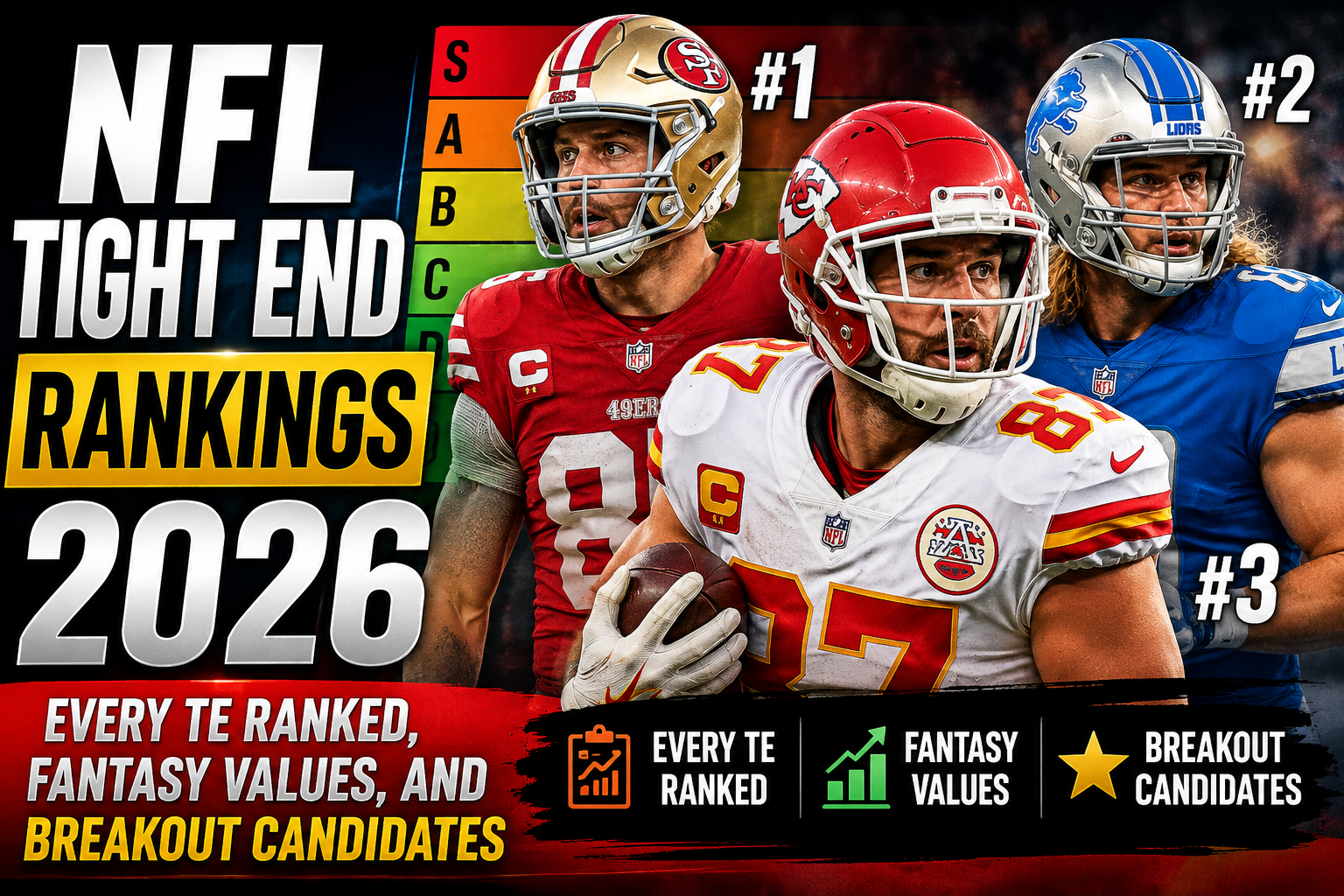
The tight end position in 2026 is defined by a fascinating combination of elite talent at the very top, a historically wide drop-off into the middle tier, and several genuinely compelling breakout candidates who could dramatically reshape the position’s fantasy hierarchy by midseason. How you navigate the tight end position in your fantasy draft will significantly impact your season-long competitiveness.
This comprehensive guide ranks every significant NFL tight end entering 2026, provides detailed real-world and fantasy analysis, identifies the breakout candidates worth targeting early, and flags the injury situations that introduce risk at the position’s expensive upper tier. Whether you are drafting tight end early or streaming throughout the season, this is the resource you need.
The 2026 Tight End Landscape: What Has Changed
Several significant developments have reshaped the tight end position heading into 2026. Travis Kelce’s contract situation and Patrick Mahomes’ injury create genuine uncertainty around the player who has defined the position for a decade. George Kittle’s Achilles recovery introduces health risk for the position’s second-most-valuable fantasy asset. And Kyle Pitts’ franchise-tagged breakout season has elevated him from disappointment narrative to legitimate top-three TE option.
The middle tier of the position — once populated by reliable-but-unspectacular players who provided consistent production at modest price — has been disrupted by Sam LaPorta’s emergence in Detroit and T.J. Hockenson’s return from injury in Minnesota. These players have redefined what a reasonable expectation looks like for a Round 3-5 TE investment.
Tier 1: Elite Tight Ends (Draft in Rounds 2-4)
#1 — Kyle Pitts, Atlanta Falcons
Kyle Pitts earns the No. 1 tight end ranking entering 2026 based on the combination of his franchise tag season’s breakout performance and the straightforward role he plays in Atlanta’s offense. When Pitts is the first option in the passing game — which he increasingly is — his size-speed combination creates matchup problems that no team in the NFC can handle consistently. At 6-foot-6 with sub-4.5 speed, he is physically unlike any other tight end in football.
The Falcons’ commitment to featuring Pitts — reflected in the franchise tag and ongoing extension negotiations — signals that Atlanta intends to make him the centerpiece of their passing attack. A long-term extension, if completed before training camp, removes the distraction element and allows Pitts to focus entirely on a season that could produce numbers challenging the all-time TE records.
- Fantasy outlook: TE1 overall in 2026; draft in Round 2-3 of most formats
- Real-world outlook: Legitimate All-Pro candidate if the Falcons’ offense functions to its potential
- Risk factor: Extension negotiations; Falcons’ offensive line quality
#2 — Travis Kelce, Kansas City Chiefs
Travis Kelce’s ranking as No. 2 overall tight end requires significant qualification in 2026. Patrick Mahomes’ absence — whether for weeks or months — fundamentally alters Kelce’s target volume and production ceiling. Without Mahomes’ ability to find him on the third or fourth read of a play, Kelce’s role in Kansas City’s offense becomes more predictable and more defensible.
The contract situation adds further uncertainty. If Kelce and the Chiefs resolve their financial discussions with a restructure that reflects both sides’ commitment, his production should remain near his 2025 levels. An unhappy Kelce playing through a contract dispute is a meaningfully different fantasy asset than a motivated Kelce playing for one last championship.
- Fantasy outlook: TE1 with significant qualification — draft as TE2 and treat any production above that as gravy
- Real-world outlook: His legacy and motivation make him dangerous even in a diminished role
- Risk factor: Mahomes’ absence, contract situation, age (36)
#3 — George Kittle, San Francisco 49ers
George Kittle’s Achilles recovery is the most consequential health storyline at the tight end position entering 2026. When healthy, Kittle is a top-3 fantasy tight end whose combination of route running, yards-after-catch, and blocking make him the most complete player at the position in the sport. The Achilles injury introduces genuine uncertainty about his Week 1 availability and his explosiveness when he does return.
The 49ers’ offensive system — built around Kittle’s unique ability to operate as both a traditional tight end and an in-motion receiver — is specifically designed to maximize his production when healthy. Kyle Shanahan’s creative deployment of Kittle in motion, in-line, and in the slot creates situations where defenses cannot cover him with a single player regardless of formation.
- Fantasy outlook: Draft as TE1 only if his health situation clarifies before your draft; otherwise target as a high-risk TE2
- Real-world outlook: Elite when healthy; the 49ers cannot replace his production from any other roster position
- Risk factor: Achilles recovery timeline; Week 1 availability uncertain
Related: NFL Injury Return Timelines 2026: Kittle, Mahomes, and Every Major Player
Tier 2: Reliable Fantasy Starters (Draft in Rounds 4-7)
#4 — Sam LaPorta, Detroit Lions
Sam LaPorta’s emergence as one of the NFL’s best young tight ends was one of 2025’s most rewarding fantasy stories. His route running is NFL-ready beyond his experience level, his chemistry with Jared Goff produces consistently clean targets, and Dan Campbell’s offense features him prominently in a way that creates weekly production reliability. In 2026, with a full offseason of scheme familiarity, LaPorta projects as a top-5 fantasy tight end.
#5 — David Njoku, Cleveland Browns
David Njoku’s value in 2026 is directly tied to the Browns’ quarterback situation. With a competent starter under center, Njoku’s size, speed, and receiving ability make him a weekly TE1 candidate. His red zone presence — consistently one of the better big targets in the league — ensures touchdown upside even in weeks when his overall target volume is modest.
#6 — T.J. Hockenson, Minnesota Vikings
Hockenson’s return from his ACL injury in 2025 was encouraging, and his chemistry with Sam Darnold (or whoever starts for Minnesota) gives him a clear path to top-6 tight end production. His receiving skills are genuinely elite — he runs routes with the precision of a wide receiver, creating separation that most tight ends cannot generate.
#7 — Cole Kmet, Chicago Bears
Cole Kmet’s value is significantly elevated by the arrival of Ben Johnson as the Bears’ offensive coordinator. Johnson’s Detroit system featured the tight end creatively in the passing game — using the position as a movable piece in multiple alignments rather than a traditional in-line blocker. If Kmet is deployed similarly in Chicago, his fantasy production could jump dramatically from his historical output.
Related: Chicago Bears 2026 Season Preview: Ben Johnson’s Offense Unleashed
Tight End Breakout Candidates in 2026
Kyle Pitts — The Obvious Choice
Pitts’ breakout already happened in 2025 — but the 2026 season could represent the true arrival of what scouts always projected when they compared him to elite tight ends at the height of their powers. An extension that removes distraction, a quarterback who trusts him, and an offensive system designed around his unique skill set combine to create the conditions for a historic tight end season.
Brock Bowers — Las Vegas Raiders
Brock Bowers was one of the 2025 draft’s most highly-touted tight end prospects, and his first season in Las Vegas has generated significant positive buzz despite the Raiders’ organizational challenges. Bowers’ receiving skills are legitimate — clean routes, reliable hands, and the ability to create yards after contact. If Las Vegas stabilizes its quarterback situation in 2026, Bowers becomes a legitimate top-5 fantasy tight end.
Tucker Kraft — Green Bay Packers
Tucker Kraft has been the Packers’ most consistent receiving weapon in limited opportunities, and Jordan Love’s continued development as a passer specifically targets tight end routes in ways that benefit Kraft’s target volume. In 2026, with more defensive attention drawn by the emerging receiver group, Kraft’s opportunities from the middle of the field could produce surprising production.
Frequently Asked Questions: NFL Tight Ends 2026
Q: Who is the No. 1 fantasy tight end in 2026?
A: Kyle Pitts of the Atlanta Falcons is the consensus No. 1 fantasy tight end entering 2026, based on his franchise tag breakout season and the Falcons’ commitment to featuring him as the centerpiece of their passing attack.
Q: Is Travis Kelce worth drafting in 2026?
A: Kelce carries more risk than his name recognition suggests in 2026 due to Patrick Mahomes’ ACL absence, his age (36), and his contract situation. Draft him as a TE2 and treat production above that as a bonus rather than an expectation.
Q: Should I draft a tight end early or stream the position in 2026?
A: Unless Kyle Pitts or Travis Kelce is available in the second or third round, streaming tight end is a viable strategy in 2026 given the depth in the middle tier. The resource cost of drafting Sam LaPorta or David Njoku in Round 5-6 may be better deployed elsewhere.
Q: Which tight end will have the biggest breakout in 2026?
A: Kyle Pitts is the most obvious breakout candidate at the position. Brock Bowers in Las Vegas is the dark horse — if the Raiders find their quarterback answer, Bowers’ receiving talent could produce top-3 TE numbers at a much lower draft cost.




No comment