
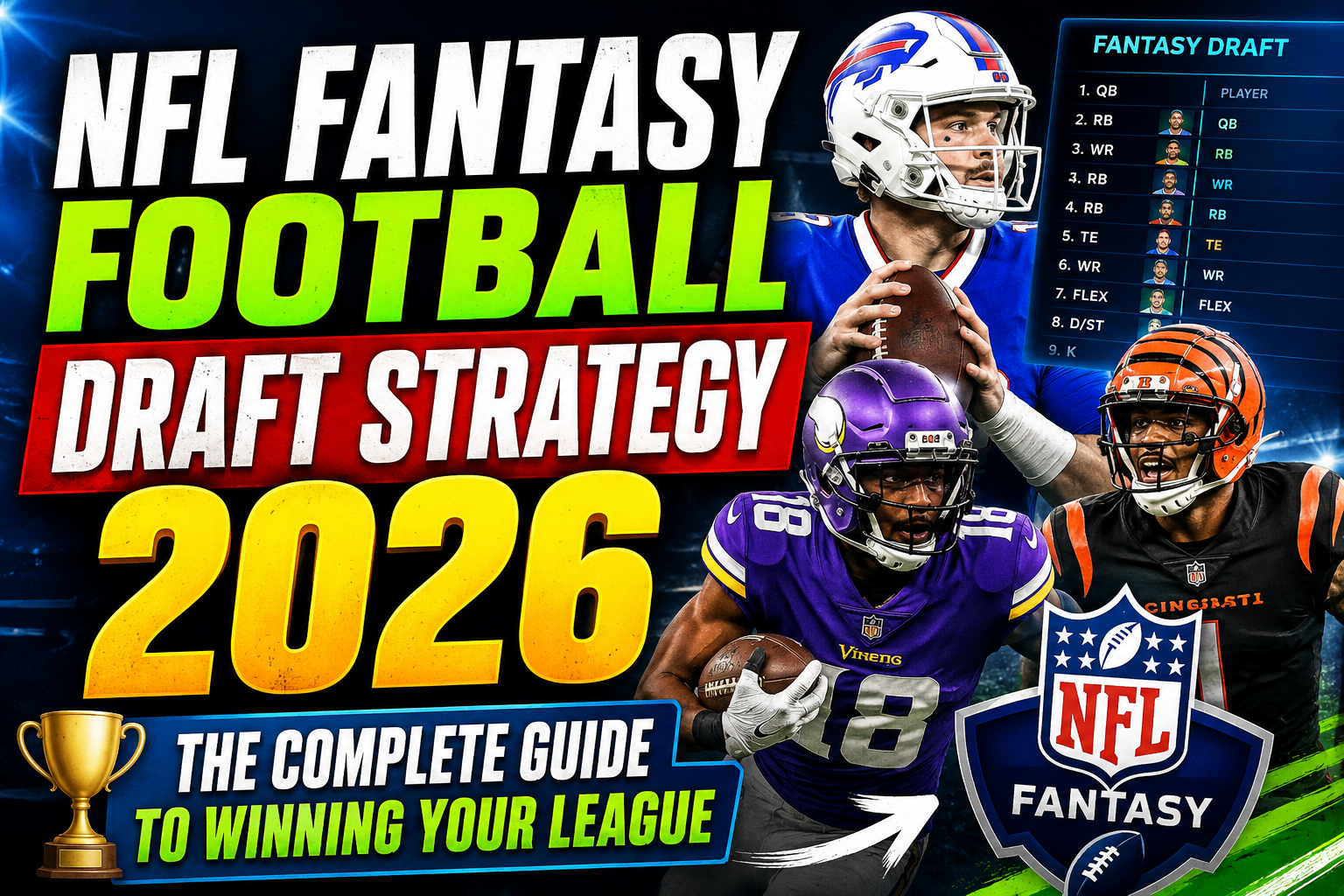
Fantasy football success is built in the draft. The managers who win championships in February are almost always the ones who made sound decisions in August — identifying value, avoiding over-hyped disappointments, and constructing rosters with the right balance of floor and ceiling. In 2026, the fantasy landscape is more dynamic than it has been in years, with multiple position groups undergoing significant changes that create exceptional opportunities for informed managers and dangerous pitfalls for those operating on outdated information.
This is the definitive 2026 NFL fantasy football draft strategy guide — covering every format, every position, the best values at every ADP tier, the sleepers worth targeting in the final rounds, and the high-profile players whose ADP significantly overestimates their realistic 2026 production. Follow this guide and you will enter your draft with a meaningful edge over the field.
Understanding the 2026 Fantasy Football Landscape
Before building a draft strategy, every serious fantasy manager should understand the macro-level shifts that define the 2026 player pool. Three themes dominate this year’s fantasy landscape:
First, quarterback scarcity is reduced. With Shedeur Sanders, Jaxson Dart, Garrett Nussmeier, and Cam Ward all in their first or second seasons, the mid-tier quarterback pool is deeper than usual — which means waiting on quarterback is a viable and often optimal strategy in single-QB formats. The premium quarterbacks (Jackson, Allen, Hurts, Stroud) are worth their early-round price; everyone else can wait.
Second, the running back position is simultaneously excellent at the top and extremely thin in the middle. Bijan Robinson, Christian McCaffrey, Derrick Henry, Breece Hall, and Jeremiyah Love form an elite top tier — but the drop-off after Pick 8-10 at running back is steeper than in recent years. This creates a bifurcated strategy: either secure two top-10 running backs in the first three rounds, or accept that you will be streaming the position for much of the season.
Third, wide receiver is the deepest it has been in a decade. The 2026 receiver pool features genuine quality through the sixth and seventh rounds, meaning managers who load up on running backs early and pivot to receivers in the middle rounds can build balanced rosters without sacrificing WR quality.
Related: NFL Running Back Rankings 2026: Full Tier List and Fantasy Values
Round-by-Round Draft Strategy: Standard 12-Team PPR
Rounds 1-2: Anchor Your Roster
The first two rounds of a fantasy draft establish your roster’s foundation. In 2026, the correct approach for most draft positions is running back heavy. Bijan Robinson and Christian McCaffrey at Picks 1-2 are the consensus top selections — both represent the elite combination of usage, efficiency, and receiving ability that produces consistent weekly floor scores. If you are picking in the 1.03-1.06 range, Derrick Henry and Breece Hall are the targets.
Wide receivers become viable in the late first round — CeeDee Lamb at 1.06-1.08 and Justin Jefferson at 1.07-1.09 represent fair value for their ADP. The mistake managers make is reaching for receivers like Ja’Marr Chase or Davante Adams at top-5 picks when superior running back options remain on the board. Patience at wide receiver pays dividends in the middle rounds where the position is deepest.
Tight end in the first two rounds is only justified if Travis Kelce or George Kittle (health permitting) falls unexpectedly. Sam LaPorta and Kyle Pitts — often drafted in the second round — represent overpays given the depth at the position and the value available at other positions in that ADP range.
Rounds 3-5: Build Your Ceiling
Rounds 3 through 5 are where fantasy championships are built or lost. The managers who identify undervalued players in this range and secure them before the field wakes up consistently outperform their draft position. In 2026, the highest-value targets in this range include:
- Jeremiyah Love (Cardinals RB) — if he falls past Round 2, he is the steal of your draft at any Round 3 pick
- Jaxon Smith-Njigba (Seahawks WR) — consistent target volume and elite receiving skill make him a WR1 at a WR2 price in Round 3-4
- Jahmyr Gibbs (Lions RB) — his receiving ability and explosive upside make him a top-12 back when healthy; target aggressively if he falls
- Rome Odunze (Bears WR) — the Ben Johnson effect on Bears receivers will be dramatic; Odunze’s target share in Johnson’s system makes him a value through Round 5
- Makai Lemon (Eagles WR) — contingent on the A.J. Brown situation; if Brown is traded, Lemon becomes a Round 2-3 value at his current Round 4-5 ADP
Rounds 6-10: Sleepers and Handcuffs
The middle rounds of a fantasy draft are where sleepers are secured and handcuffs are collected. In 2026, the key strategies for Rounds 6-10 are: handcuffing your elite running backs immediately (the drop-off in production when a top-5 back goes down is catastrophic without a capable backup), targeting receivers in systems with established high target volume, and being selective about quarterback if you have waited this long.
- Carnell Tate (Titans WR) — the most undervalued receiver in the 2026 draft at his Round 7-8 ADP
- Tank Dell (Texans WR) — reliable target volume in a Stroud-led offense makes him a consistent producer
- Zay Flowers (Ravens WR) — the most important receiver in Lamar Jackson’s evolving passing attack
- Handcuff RBs: The backup to Bijan Robinson, Christian McCaffrey’s handcuff, and Breece Hall’s backup are worth taking in Rounds 7-9 depending on what you own
Rounds 11-15: High Upside, Low Floor
The final rounds of your draft are for lottery tickets — players whose situations create legitimate breakout potential even if the probability of that breakout is below 50%. In 2026, the best late-round targets include Shedeur Sanders (QB, if he wins the starting job in Cleveland), any receiver who benefits from a mid-season trade or depth chart change, and handcuffs to any running backs taken in the middle rounds whose backup situations are unclear.
Related: NFL Fantasy Football Sleepers 2026: Best Late-Round Targets
Position Rankings: 2026 Fantasy Tiers Summary
Quarterback Tiers
- Tier 1 (Rounds 1-3): Lamar Jackson, Josh Allen
- Tier 2 (Rounds 4-6): Jalen Hurts, C.J. Stroud, Dak Prescott
- Tier 3 (Rounds 7-10): Caleb Williams, Bo Nix, Drake Maye, Jayden Daniels
- Tier 4 (Rounds 10-15): Cam Ward, Shedeur Sanders (if starting), Jaxson Dart
Running Back Tiers
- Tier 1 (Rounds 1-2): Bijan Robinson, Christian McCaffrey, Derrick Henry
- Tier 2 (Rounds 2-3): Breece Hall, Jeremiyah Love, Jahmyr Gibbs, Kenneth Walker III
- Tier 3 (Rounds 3-5): Jonathan Taylor, Saquon Barkley, De’Von Achane, Josh Jacobs
- Tier 4 (Rounds 5-8): Aaron Jones, Tony Pollard, Jerome Ford, Chuba Hubbard
Wide Receiver Tiers
- Tier 1 (Rounds 1-2): CeeDee Lamb, Justin Jefferson, Ja’Marr Chase, A.J. Brown
- Tier 2 (Rounds 2-4): Tyreek Hill, Davante Adams, JSN, George Pickens, Stefon Diggs
- Tier 3 (Rounds 4-6): D.J. Moore, Zay Flowers, DeVonta Smith, Rome Odunze
- Tier 4 (Rounds 6-9): Makai Lemon, Carnell Tate, Tank Dell, Hollywood Brown
Tight End Tiers
- Tier 1 (Rounds 2-4): Travis Kelce (if healthy/motivated), George Kittle (health dependent), Kyle Pitts
- Tier 2 (Rounds 4-6): Sam LaPorta, David Njoku, T.J. Hockenson
- Tier 3 (Rounds 7-10): Cole Kmet, Evan Engram, Dalton Kincaid
Biggest Busts to Avoid in the 2026 Fantasy Draft
Equally important to knowing who to draft is knowing who to avoid. The following players are projected to significantly underperform their current ADP in 2026:
- Davante Adams — age and reduced target volume make his Round 2-3 ADP an overpay; his 2025 production is unlikely to be repeated
- Travis Kelce — the combination of age, reduced Patrick Mahomes availability, and contract uncertainty creates too much risk for his current price
- Any Raiders skill position player — organizational instability and a quarterback situation that lacks a clear answer suppresses every Las Vegas offensive player’s ceiling
- Anthony Richardson (QB) — the fifth-year option decline and the pressure of a prove-it season create inconsistency risk that makes his current ADP dangerous for fantasy managers
Dynasty vs. Redraft Strategy Differences in 2026
Dynasty fantasy managers should prioritize differently than redraft managers in 2026. The key distinctions: rookie running backs like Jeremiyah Love carry much higher dynasty value than redraft value because their multi-year contribution window extends the investment. Veteran receivers like Davante Adams are redraft-only propositions whose dynasty value is minimal. And the rookie quarterback class — Sanders, Dart, Nussmeier — should be targeted aggressively in dynasty drafts at prices that reflect current uncertainty rather than long-term potential.
Related: NFL Rookie Minicamp 2026: Best Performers and Dynasty Targets
Frequently Asked Questions: Fantasy Football 2026
Q: Should I draft a running back or wide receiver with my first pick in 2026?
A: Running back is the recommended strategy for most draft positions in 2026. The elite backs (Robinson, McCaffrey, Henry) offer the most consistent weekly production, and the drop-off in RB quality is steeper than at receiver. If an elite WR like CeeDee Lamb falls to you at 1.06 or later, that changes the calculus.
Q: Is Travis Kelce worth drafting in 2026?
A: Kelce carries more risk than his ADP suggests in 2026. Patrick Mahomes’ absence reduces his target volume, his age introduces injury risk, and his contract situation adds uncertainty. Target him only in the fourth round or later, where the risk-reward is more favorable.
Q: Who is the best fantasy sleeper of 2026?
A: Carnell Tate of the Tennessee Titans is the most undervalued receiver in the 2026 fantasy draft at his current ADP (Round 7-8). His route-running skill, growing chemistry with Cam Ward, and expanding target share make him a legitimate WR2 by midseason.
Q: Should I draft Shedeur Sanders as a fantasy quarterback?
A: Sanders is worth a late-round flier (Round 12-15) if he is the confirmed starter in Cleveland. His rushing ability provides a fantasy floor even when the passing numbers are modest, and his upside as the season progresses is among the highest in the late-round quarterback pool.


No comment